


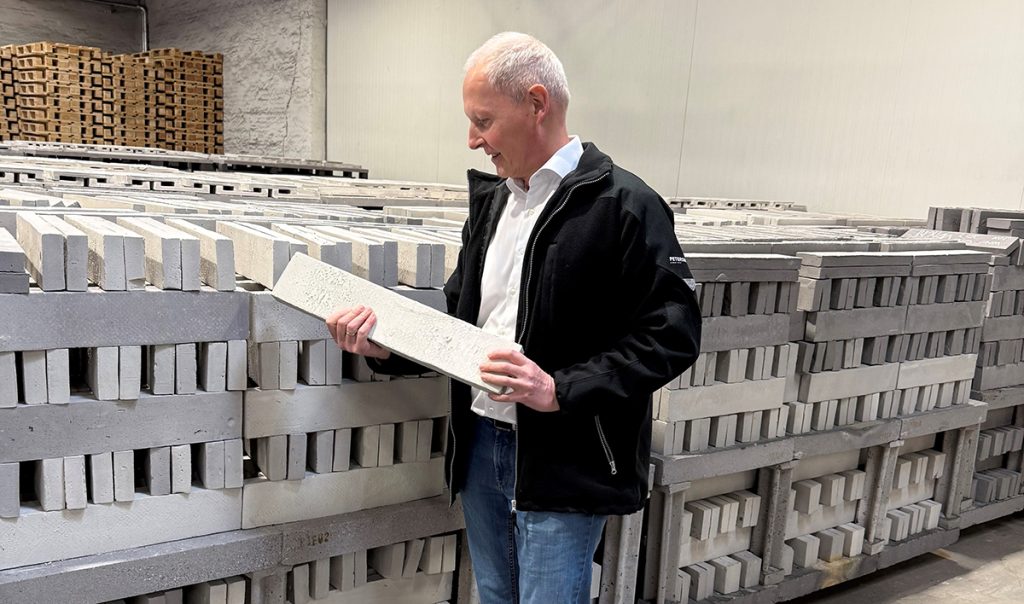
With roots dating back to 1791, Danish brick manufacturer Petersen Tegl has built a strong international position within high-end architectural bricks. Today, the family-owned company combines traditional craftsmanship with modern data tools to meet rapidly increasing demands for environmental documentation.
– We often say we are the Louis Vuitton of bricks. It’s high-end, it’s a special look, and we serve a very specific segment, both in Denmark and internationally, says Culmsee, Senior Engineer at Petersen Tegl.
Environmental requirements hitting the market “like a freight train”
In recent years, expectations around environmental documentation have changed dramatically – especially in Scandinavia.
– We’ve seen LCA requirements and CO₂ limits come into the market like a freight train. There has been a huge increase in focus within just the last year, explains Culmsee.
For manufacturers, this shift means delivering precise and reliable data to customers such as architects, contractors and developers.
– In Denmark, you simply need LCA calculations to get a building permit. So being able to provide this data is essential, he adds.
From slow processes to real-time insights
Previously, producing Environmental Product Declarations (EPDs) was both time-consuming and costly.
– We had to prepare the data ourselves and send it to a verifier. It could take two to three weeks and was quite expensive, says Culmsee.
With the introduction of the LCA.no EPD Generator, the workflow has changed significantly.
– Now we have templates and internal processes in place. We can create an EPD very quickly compared to previous prosesses, he says.
Turning environmental data into a decision-making tool
For Petersen Tegl, the real value lies in how the generator supports better decisions.
– We don’t rely on gut feeling anymore – we rely on numbers, says Culmsee.
Access to real data has already led to new insights.
– We recently compared two similar raw materials from different suppliers and transport methods. We had one expectation, but the data showed the opposite. That was a real eye-opener, he explains.
The ability to simulate different scenarios allows the company to test changes before implementing them in production.
– It gives us a clear understanding of where we need to improve and where we get the most value from our efforts, adds Culmsee.
Finding the balance between sustainability and cost
While reducing emissions is important, it must also be financially viable.
– Yes, we can improve everything, but everything has a cost. The key is to find the optimal balance, says Culmsee.
Using the generator, Petersen Tegl can model different approaches and compare their impact.
– It helps us understand where we get the most “bang for the buck” and where we should focus, he explains.
Driving internal collaboration and understanding
Working with environmental data is also strengthening collaboration across the organisation.
– It improves the general understanding across departments, says Culmsee.
Because data is easily accessible, questions can be answered quickly and fact-based.
– A colleague asked about the impact of different transport options. It took me less than 10 minutes to run the calculation and give him an answer, he says.
A foundation for future innovation
Although the company has not yet published all its EPDs, the groundwork is already in place. The generator is actively used internally to test, refine and prepare data.
Looking ahead, Culmsee is clear about the direction of the industry.
– It’s here to stay, and there will be more requirements coming. EPDs are no longer optional – they are a necessity, he says.
Advice to other manufacturers
For companies just starting their journey with environmental documentation, Culmsee has a clear message.
– Use a tool like an EPD generator. It creates transparency, makes the work easier and gives you a solid foundation for decisions, he says.
Combining tradition with modern insight
At Petersen Tegl, centuries of craftsmanship are now combined with data-driven decision-making. This positions the company to meet both regulatory demands and customer expectations in a rapidly changing market.
– When I started, we were a bit behind. So yes, there is definitely an advantage to getting ahead of this, concludes Culmsee.