


Knowledge base · Article
What is LCA? Life cycle assessment explained
Updated 30 September 2026 · 5 min read
LCA (Life Cycle Assessment) is a standardised method for calculating the environmental impact of a product throughout its entire life cycle – from raw materials to waste. Here we explain how an LCA is carried out, what it measures and what it is used for.

In brief
- LCA (Life Cycle Assessment) calculates the environmental impact of a product throughout its entire life cycle.
- The method is standardised in ISO 14040 and ISO 14044 and consists of four phases.
- The results show where in the life cycle impacts occur, and where improvements make the biggest difference.
- LCA is the basis for EPDs, which are used as documentation in tenders, building carbon calculations and green building certifications.
What is a life cycle assessment?
A life cycle assessment is a systematic mapping of the environmental and resource impacts of a product, from the extraction of raw materials until the product is disposed of or recycled. The assessment covers everything that happens along the way: manufacturing, transport, installation, use, maintenance and waste handling.
The point is to see the whole picture. A product may have low emissions at the factory, but high emissions from its raw materials or transport. Without an LCA, it is easy to optimise the wrong part of the life cycle.
The four phases of an LCA
ISO 14040 and ISO 14044 divide an LCA into four phases:
- Goal and scope: What should the study answer, and what should be included? This is where the functional or declared unit (for example 1 m² of flooring or 1 tonne of steel) and the system boundaries are defined.
- Life cycle inventory (LCI): Collection of data on everything that goes into and out of the system: raw materials, energy, transport, emissions and waste.
- Life cycle impact assessment (LCIA): The data is converted into environmental impacts, for example kg CO₂ equivalents for climate change.
- Interpretation: The results are analysed. Where do the impacts occur, how reliable are the figures, and which improvements have the greatest effect?

The life cycle in modules: from A1 to D
For construction products, the EN 15804 standard divides the life cycle into fixed modules. This makes it possible to compare products and combine them when calculating the impact of a whole building.
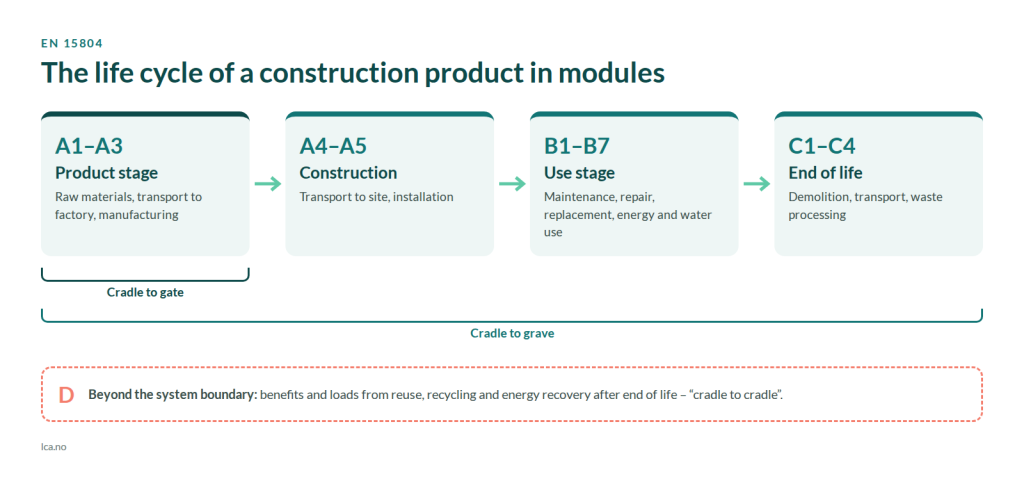
| Module | Life cycle stage | Examples |
|---|---|---|
| A1–A3 | Product stage | Raw material supply, transport to factory, manufacturing |
| A4–A5 | Construction | Transport to site, installation |
| B1–B7 | Use stage | Maintenance, repair, replacement, energy and water use |
| C1–C4 | End of life | Demolition, transport, waste processing, disposal |
| D | Beyond the system boundary | Benefits from reuse, recycling and energy recovery |
An assessment can cover all or part of the life cycle. Cradle to gate stops when the product leaves the factory (A1–A3). Cradle to grave covers the entire life cycle. Cradle to cradle also takes into account that the materials are used again.
Which environmental impacts are measured?
An LCA measures more than greenhouse gas emissions. Under EN 15804+A2, the reported indicators include:
- GWP – climate change: Contribution to global warming, measured in kg CO₂ equivalents.
- ODP – depletion of the ozone layer.
- AP – acidification of soil and water.
- EP – eutrophication of freshwater, marine and terrestrial environments.
- POCP – photochemical ozone formation, which contributes to ground-level ozone and smog.
- ADP – depletion of resources, both minerals and metals and fossil resources.
- WDP – water use.
Resource use, waste and output flows are also reported. Read more about each category in Environmental impact EN 15804+A2.
What is LCA used for?
- Documentation: LCA is the basis for EPDs, which are required in many tenders and used in carbon calculations for buildings.
- Product development: The assessment shows which materials, processes or suppliers have the largest impact, and where improvements pay off.
- Early-stage design: LCA can compare technical alternatives before decisions are made.
- Purchasing and sales: Verified figures make it possible to document a lower carbon footprint without breaching the rules against greenwashing.
LCA and EPD – what is the difference?
LCA is the analysis itself. An EPD (Environmental Product Declaration) is a concise document that presents the results of an LCA according to fixed rules. The EPD is third-party verified and published by a programme operator, so that it can be used as documentation in the market.
In other words: every EPD is based on an LCA, but not every LCA becomes an EPD. Read more in What is an Environmental Product Declaration (EPD)? and EPD – a short guide.
Questions and answers
LCA stands for Life Cycle Assessment. It is a standardised method for calculating the environmental impact of a product throughout its entire life cycle.
An LCA is the analysis that calculates the environmental impact. An EPD (Environmental Product Declaration) is a standardised, third-party verified document that presents the results of an LCA according to fixed rules – for construction products according to EN 15804.
The framework for LCA is described in ISO 14040 and ISO 14044. EPDs must also follow ISO 14025, and construction products EN 15804+A2.
It means the analysis covers the entire life cycle, from extraction of raw materials until the product is disposed of. “Cradle to gate” stops when the product leaves the factory, while “cradle to cradle” also includes recycling and reuse.
It depends on the product and how easily the data is available. With a digital EPD tool where the data foundation is already in place, new assessments and EPDs can be produced much faster than in a traditional consultancy project.
Want to know what your products actually emit?
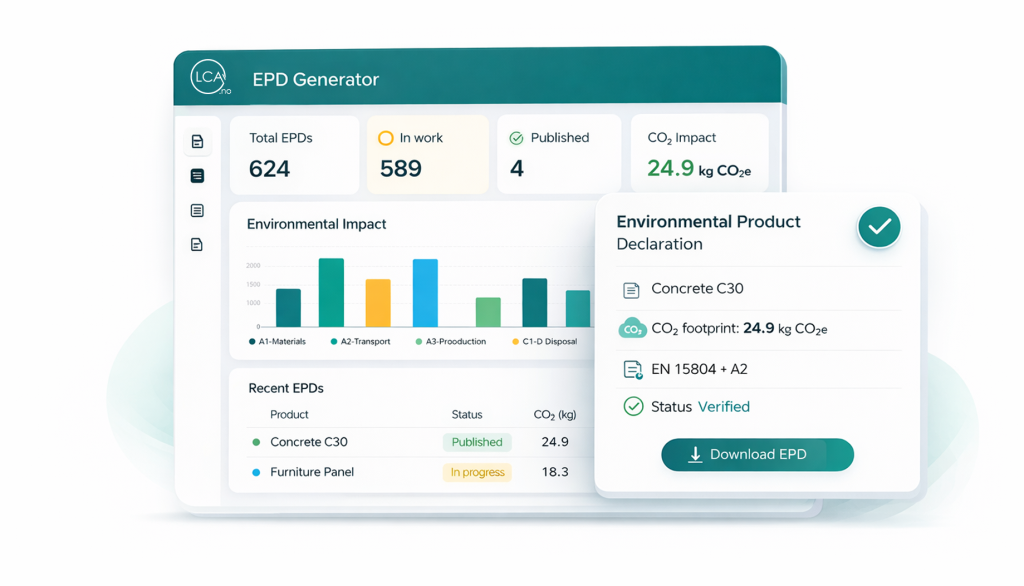
With the EPD Generator from LCA.no, you create LCAs and third-party verified EPDs yourself – faster and at lower cost than with traditional processes.
Book a demoSources
- ISO 14040:2006 Environmental management – Life cycle assessment – Principles and framework
- ISO 14044:2006 Environmental management – Life cycle assessment – Requirements and guidelines
- EN 15804:2012+A2:2019 Sustainability of construction works – Environmental product declarations – Core rules for the product category of construction products
First published on lca.no on 5 February 2025. Updated 30 September 2026.
Contents