


Not just construction: new EU regulation and public procurement are making verified environmental documentation decisive for competing, in every industrial sector. Figures, deadlines and real-world cases for Italian companies.
For years, product environmental documentation, starting with the Environmental Product Declaration (EPD), was seen mainly as a formality: something needed to win a tender or satisfy a technical specification, almost always in construction. The regulatory landscape taking shape between 2026 and 2032 is changing that picture for a far wider group of companies than construction material producers alone, from textiles to furniture, electronics to chemicals, all the way to consumer goods. Verified environmental documentation is becoming a competitive asset, and the quality of the data a factor that separates the companies that win contracts from those left out.
These themes are the subject of a free webinar, “EPD: from compliance to competitiveness,” on 1 October 2026 — details at the end of this article.
What is an EPD, and why does it matter more today
An EPD (Environmental Product Declaration) is a Type III environmental declaration, verified by an independent third party, that transparently communicates the environmental impact of a product or service across its entire life cycle. It rests on Life Cycle Assessment (LCA), the methodology used to calculate the overall environmental footprint of a material, a product or a whole building over its full service life (ISO 14040). The EPD follows the international standard ISO 14025, which applies to any product category: from construction products, for which the relevant European standard is EN 15804, to consumer goods, furniture, textiles, electronics, chemicals and services. Each category has its own Product Category Rules (PCR), the technical rules that define what to measure and how. The system was born in Sweden in 1998 and developed in Norway by EPD-Global from 2002 onward; today it counts more than twenty harmonised Program Operators across Europe through ECO Platform, active across dozens of product categories.
The European regulatory push: from the Construction Products Regulation (CPR) to the Digital Product Passport
Two European regulations of different scope are redrawing the rules for product environmental documentation. The CPR, Regulation (EU) 2024/3110, applies specifically to construction products: phased in from 8 January 2026, it brings environmental information, in particular the declared GWP, directly into the Declaration of Performance and Conformity (DoPC), a prerequisite for CE marking. The ESPR (Ecodesign for Sustainable Products Regulation), Regulation (EU) 2024/1781, has horizontal scope instead: it applies to almost all product categories placed on the European market, regardless of origin. It’s the ESPR that introduces the Digital Product Passport (DPP), gathering structured, machine-readable information across a product’s entire life cycle: material composition, production processes, climate and environmental impact, guidance on use and repair, and end-of-life instructions, via QR code or another digital identifier.
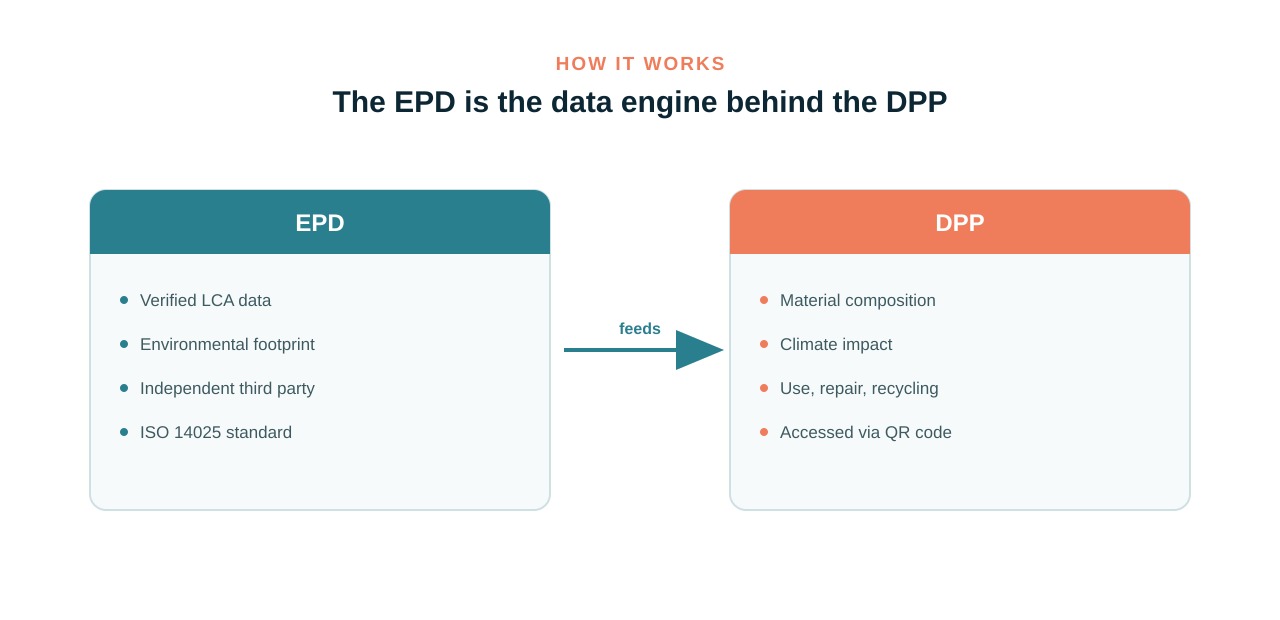
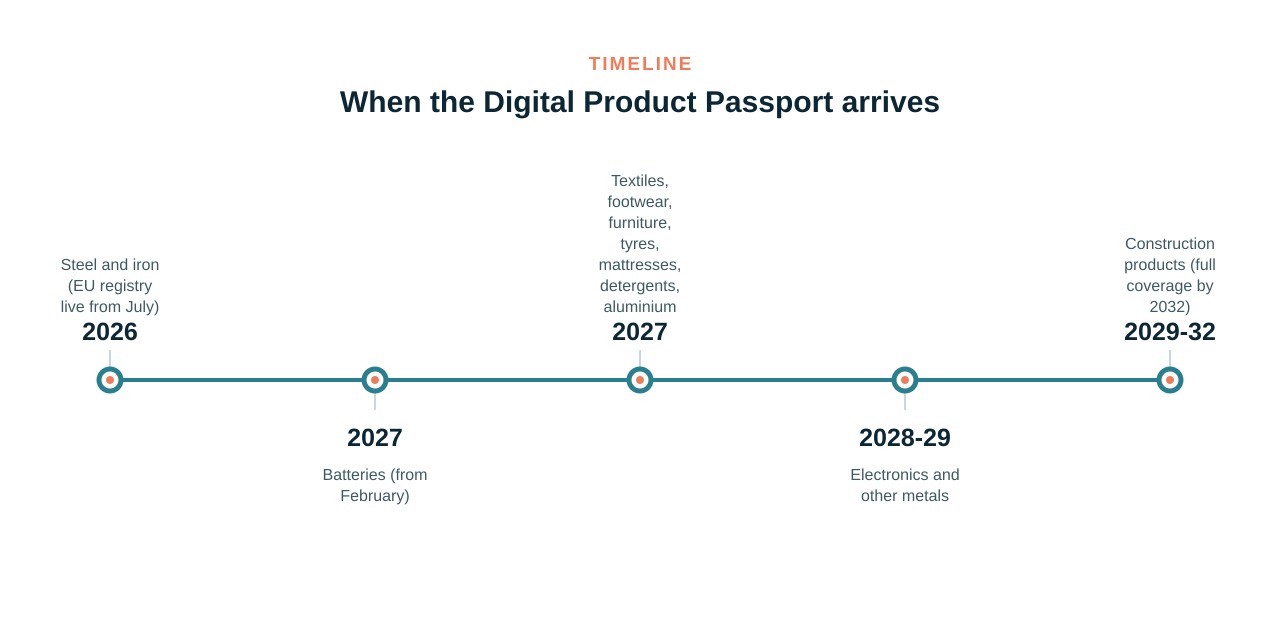
The rollout timeline is already set: steel and iron from 2026, with the EU DPP registry operational from July; batteries from February 2027; textiles, footwear, furniture, tyres, mattresses, detergents and aluminium in 2027; electronics and other metals in 2028-29. For construction products, the obligation is expected between 2029 and 2030, with full coverage by 2032. Much of what the DPP requires overlaps with what an EPD already documents: the EPD is, in this scheme, the data engine the DPP is built on. Companies that already hold solid EPD certifications and the underlying LCA studies start from a position of advantage once the obligation reaches their sector, whether that’s construction, textiles, electronics or furniture.
Italy and the leverage of public procurement
In Italy, the shift is being driven above all by public procurement, and it isn’t limited to construction. The Public Contracts Code (Legislative Decree 36/2023, Article 57) makes Minimum Environmental Criteria (CAM) mandatory in all tenders, in line with Italy’s national action plan for Green Public Procurement (PAN GPP). CAM criteria cover a range of product and service families, from construction to office furniture, public lighting to textiles, catering to paper. The most recent update concerns construction: the new decree on CAM Edilizia (in force from 2 February 2026) replaces Decree 256/2022 and aligns environmental requirements with the CPR and the EPBD, shifting the focus from self-declaration to data verified by accredited bodies, a model set to extend to the other sectors covered by CAM too. The consequence for manufacturers is direct, whatever sector they sell to public administrations in: they need to document their products’ environmental profile with certified, not self-declared, data.
From compliance to competitiveness
The shift under way in the market can be summed up in three stages. Yesterday, having an EPD was a documentary requirement to qualify for tenders. Today, environmental data is transparent and products are benchmarked against one another: buyers compare results rather than simply checking that documentation exists. Tomorrow, and already partly today, companies win on performance: a lower carbon footprint and stronger environmental indicators become preferential criteria in public tenders, while the absence of environmental documentation increasingly means exclusion from the market before technical evaluation even begins.
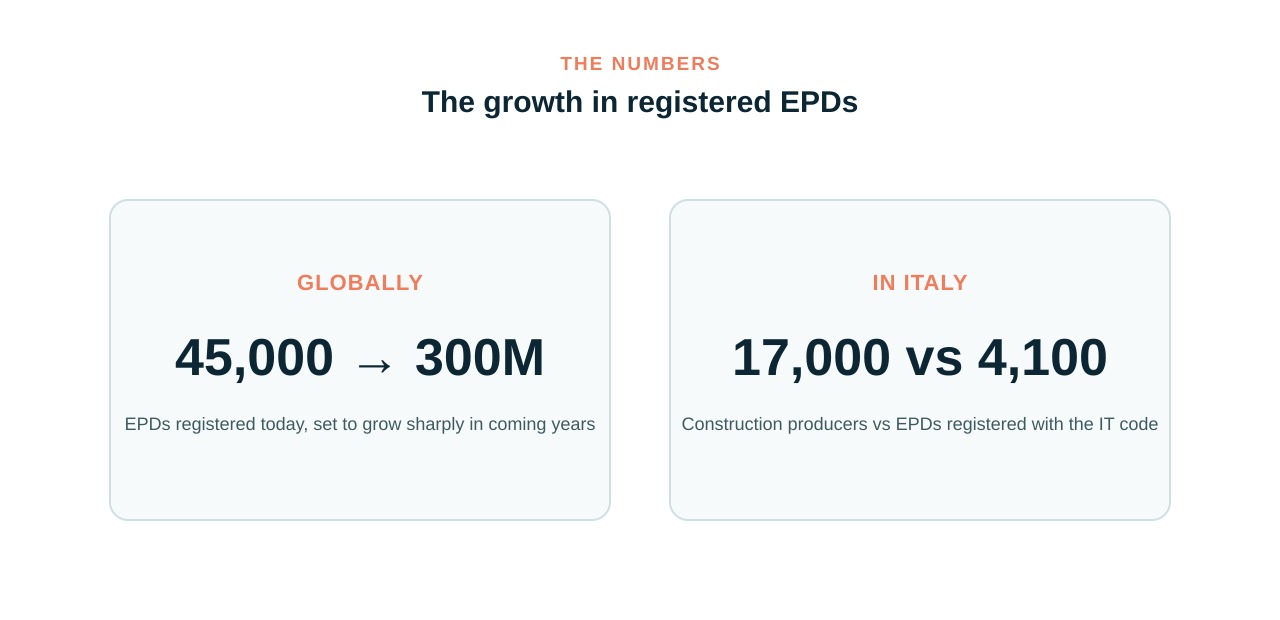
The numbers help measure the scale of the change: globally, the number of registered EPDs is expected to grow from around 45,000 today to more than 300 million in the coming years. One example: in Italy, against roughly 17,000 companies producing construction products, only around 4,100 EPDs with the IT country code are currently registered in the ECO Platform Portal, a gap that points to a wide margin of growth for companies that move early.
The digitalisation lever: from verified data to continuous improvement
Managing volumes at this scale with traditional methods, LCA studies produced manually one at a time, isn’t sustainable. This is where digital tools such as the EPD-generator developed by LCA.no come in: a fully digitalised platform, based exclusively on verified data, that produces EPDs in machine-readable formats (ISO 22057, PDT/PTS) that integrate with DoPC, DPP and BIM applications, letting manufacturers obtain EPD certification faster and at lower cost than traditional methods. Because the system works on verified data linked directly to the product’s “recipe,” it’s also possible to change raw materials, transport or energy consumption in production and update the documentation accordingly: the EPD stops being a static, one-off document and becomes a working tool for reducing carbon footprint with verifiable data.
For companies, preparing for the DPP means starting a structured process now: mapping which product categories and markets are involved, taking stock of the documentation already available, and organising product data in a structured, updatable format, often integrating existing systems (ERP, PIM, PLM, LCA tools) with dedicated solutions. Companies that start with a pilot on selected products, then scale gradually while investing in training, tend to be better prepared by the time requirements become mandatory.
Some real-world cases confirm the advantage isn’t only theoretical: in flooring, EPD certification of an entire product range was the condition for being admitted to supply a construction project; in HVAC, EPD certification made it possible to quantify and communicate a 40% reduction in in-use emissions compared with a generic air-conditioning unit, turning an environmental data point into a commercial argument.
The topic of the 1 October webinar
These themes, from the European regulatory framework to the pressure of Italian public procurement, from a manufacturer’s perspective to the technical and digital dimension of certification, will be at the centre of the free webinar “EPD: from compliance to competitiveness. Environmental performance, verification and digitalisation: how product competitiveness is changing,” scheduled for 1 October 2026. The speakers focus mainly on construction, among the sectors most exposed to regulatory pressure right now, but the principles discussed hold for any company dealing with environmental documentation, regardless of industry. The event is jointly organised by LCA.no, Mapei Spa, EPD-Global and Greenwich a SOCOTEC Company, with Håkon Hauan (CEO of EPD-Global and Chairman of ECO Platform AISBL), Mikaela Decio (Corporate Environmental Sustainability Manager, Mapei Spa), Vanessa Malerba (Project Leader, Greenwich a SOCOTEC Company) and Daniela Hovland (Key Account Manager, LCA.no).
To see how it works in practice, you can request a demo of the EPD-generator platform.