


New EU requirements for Digital Product Passports (DPP) are approaching the construction industry. A new pilot project shows why it pays to take control of your product data now.
Within a few years, digital product passports will become mandatory for most products sold in the EU, including construction products. But how should industry players prepare for the change ahead?
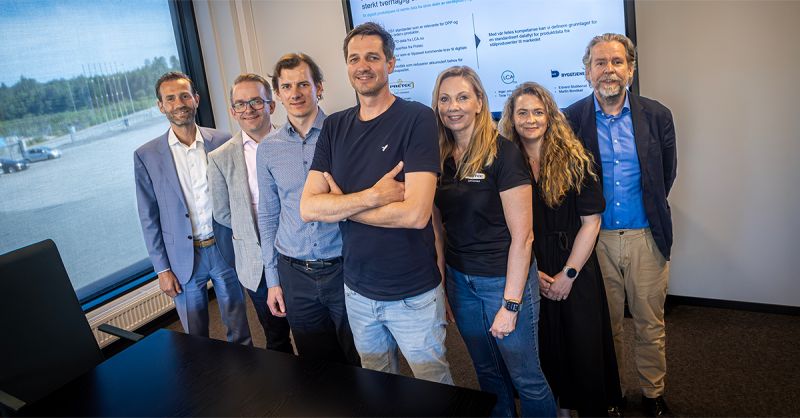
To find practical answers, we at LCA.no joined forces with supplier Pretec, Byggtjeneste and GS1 Norway in a pilot project. The goal was not to build a finished DPP solution, but to uncover the real challenges of connecting product data, identifiers, climate data and value-chain data in practice.
Learning and confidence
For Pretec, a leading supplier of steel products to the construction industry, joining was an easy decision. The company is in the middle of a broader digitalisation process and wants to stay ahead of the requirements that will hit the industry.

“We really wanted to take part, to make ourselves as well prepared as possible for what’s coming,” says Nina Pettersen, CEO of Pretec.
The project confirmed that the supplier is far ahead when it comes to its own product data and processes – while also revealing where the challenges lie.
“The project has been extremely useful for us. We’re now even more confident that the digital investment we’ve committed to is the right path to meet future requirements,” says Pettersen.
Mikael Tangen, Documentation Coordinator at Pretec, agrees:
“We’re taking a lot of learning from this. Concretely, we can now clearly see which data we need to have in place digitally, with a particular focus on optimising data collection at the point of purchasing.”
Collaboration is key
For Byggtjeneste, the purpose of the project was to turn theory into practice together with the industry. Digital product passports can seem both extensive and complicated.

“We believe developing standards behind closed doors is risky. There’s no guarantee they’ll turn out to be practically usable,” says Mikkel Nielsen, Managing Director of Byggtjeneste.
“By trying to translate the standards into practical work, and testing whether we actually get the data through the digital value chain, we gain valuable experience to bring back into the standardisation work – so we end up with a good balance between the optimal picture and what’s actually achievable in practice,” he continues.
Nielsen points out that Byggtjeneste has little faith in building systems without close dialogue with the people who will actually use them.
“We depend on testing, along the way, how solutions like this should be built. We’ve now tested it on paper and had a number of eye-opening moments, which puts us in a better position to carry out future development work.”
A possible foundation for DPP
Digital product passports will gather and share all relevant information about a product’s origin, materials and environmental footprint. The passport will also become an absolute requirement for market access.

“DPP is important for the construction industry because it increases traceability, enables sustainable choices and helps reduce the climate footprint. It will also become a criterion for placing products on the European market,” says Martin Bondkall, Director of Customer, Concept and Standard at Byggtjeneste.
So what role does Byggtjeneste want to play once digital product passports become part of everyday business?
“I think most people expect us to deliver this the same way we’ve delivered product data for 30 years. For us, it’s natural to think we’ll become a DPP service provider,” says Bondkall.
Climate data is central

Another participant in the DPP pilot project is GS1 Norway, which provides standards for globally unique identifiers that link the physical product to its digital data.
“To make a product work across its lifecycle, you need a persistent identifier – one that doesn’t expire tomorrow. GS1 Digital Link is a technology that makes it possible to reach a product’s data, regardless of where it’s stored,” explains Knut Mathisen, Head of Construction Industry at GS1 Norway.
While no one is entirely certain what the DPP will ultimately look like, some requirements are already clear.
“Climate data is one of the requirements we know is coming in the digital product passport. For that data to be used effectively, it has to be digitalised first. Only then can climate data from an EPD be fed directly into a DPP,” says Inger Johanne Brodal Dahl, Key Account Manager at LCA.no.

She stresses that manufacturers shouldn’t wait for every detail of the product passport to be finalised.
“Now is the right time to map out the relevant data points, start the digitalisation process and put a plan in place for climate documentation – so the groundwork is ready once the requirements land,” she explains.
Start the work today
Mikkel Nielsen at Byggtjeneste agrees, and has a clear message for the whole industry.
“Digital product passports will affect everyone who sells composite goods in the EU, including smaller companies. Start by mapping what data you have, where it’s stored, and who in the company should be responsible for it. That work should start immediately,” Nielsen stresses.

His colleague Edvard Stubberud, Digital Concept Developer at Byggtjeneste, closes with a concrete tip:
“There’s certain data we’re confident will be required in machine-readable format – for example the declaration of performance and environmental data. Start there, and you’ve already taken a solid step in the right direction on digital product passports.”
Key takeaways:
- Digital Product Passports (DPP) will become mandatory within a few years for most products sold in the EU, including construction products.
- We at LCA.no, together with Pretec, Byggtjeneste and GS1 Norway, tested in a joint pilot project how product data, identifiers, climate data and value-chain data can be connected in practice.
- Climate data from an EPD must be digitalised before it can be used directly in a digital product passport.
- Start mapping your own data points now – don’t wait for every requirement to be finalised.
The digital product passport is coming – and those who start preparing now will be better positioned once the requirements take effect.