


The Digital Product Passport (DPP) is on its way to the construction industry, and it will change how manufacturers create and share product information. Suppliers can already start preparing by getting their EPDs in order.
The Digital Product Passport is part of the EU’s Ecodesign for Sustainable Products Regulation (ESPR), which covers a wide range of products. For construction products, the passport is introduced through the Construction Products Regulation (CPR).
The passport will be phased in as the EU sets requirements for each product group. In a few years, each product will carry a QR code, an NFC chip or similar, linking to information such as its CO₂ footprint, durability, recyclability and content of hazardous chemicals.
This means suppliers must be able to collect and document data for their products. LCA.no’s advice is to start preparing now.
“Companies should start preparing the product categories that will need a Digital Product Passport. If they haven’t already appointed someone responsible, they should find people who can map where the information sits in the company,” says Ali Khan, LCA Specialist at LCA.no.

Start with the EPD
The product passport will give companies, consumers, repairers, recyclers and authorities access to reliable product information in an open and standardised digital format.
Among other things, the passport will contain information on the product’s climate and environmental impact, calculated according to the same standard as an EPD (EN 15804). Data from the product’s EPD can therefore be used in the passport. It is a major advantage if the EPD exists as digital data and not only as a PDF, so the information can be transferred directly.
Companies that have not yet got their EPDs in order may find it hard to meet the mandatory requirements of the passport. That is why it pays to get started with EPDs now and to keep track of when the requirements take effect for your product groups.
“Environmental data makes up a large part of the Digital Product Passport. If a company has its environmental data in place, it has already done much of the work. If it doesn’t have EPDs yet, a much bigger job lies ahead,” says Cato Hansen, Key Account Manager at LCA.no.
From PDF to data
LCA.no has developed EPD Generator, which lets manufacturers create new EPDs for their own products quickly and at low cost.
“Right now, it’s about companies taking control and ownership of the data for their own products, and making sure everything is digitalised. We talk with our customers about how to start digitalising their product information, so it’s ready for the Digital Product Passport,” says Cato Hansen, Key Account Manager at LCA.no.
Cato Hansen, Key Account Manager at LCA.no, points out that EPD Generator helps companies move away from static PDF documentation to data. Customers already using the tool therefore have control over much of the information that must be made available in the passport.
The requirements are not final
The detailed requirements for the construction industry’s Digital Product Passport are not yet in place. Ali Khan, LCA Specialist at LCA.no, expects the requirements for company data to change along the way, as they did when the EPD was introduced.
“It’s hard to know in advance what the requirements will be, but EPD Generator is a flexible system, so we can adapt the tool to the requirements. For companies, it’s important to have people ready who have the responsibility and authority to share the information in the Digital Product Passport,” says Ali Khan, LCA Specialist at LCA.no.
Meet LCA.no at Building Green

LCA.no is exhibiting at Building Green CPH 2026 at Lokomotivværkstedet in Copenhagen on 28–29 October. At stand 81 you can meet Inger Johanne Brodal Dahl, Key Account Manager at LCA.no.
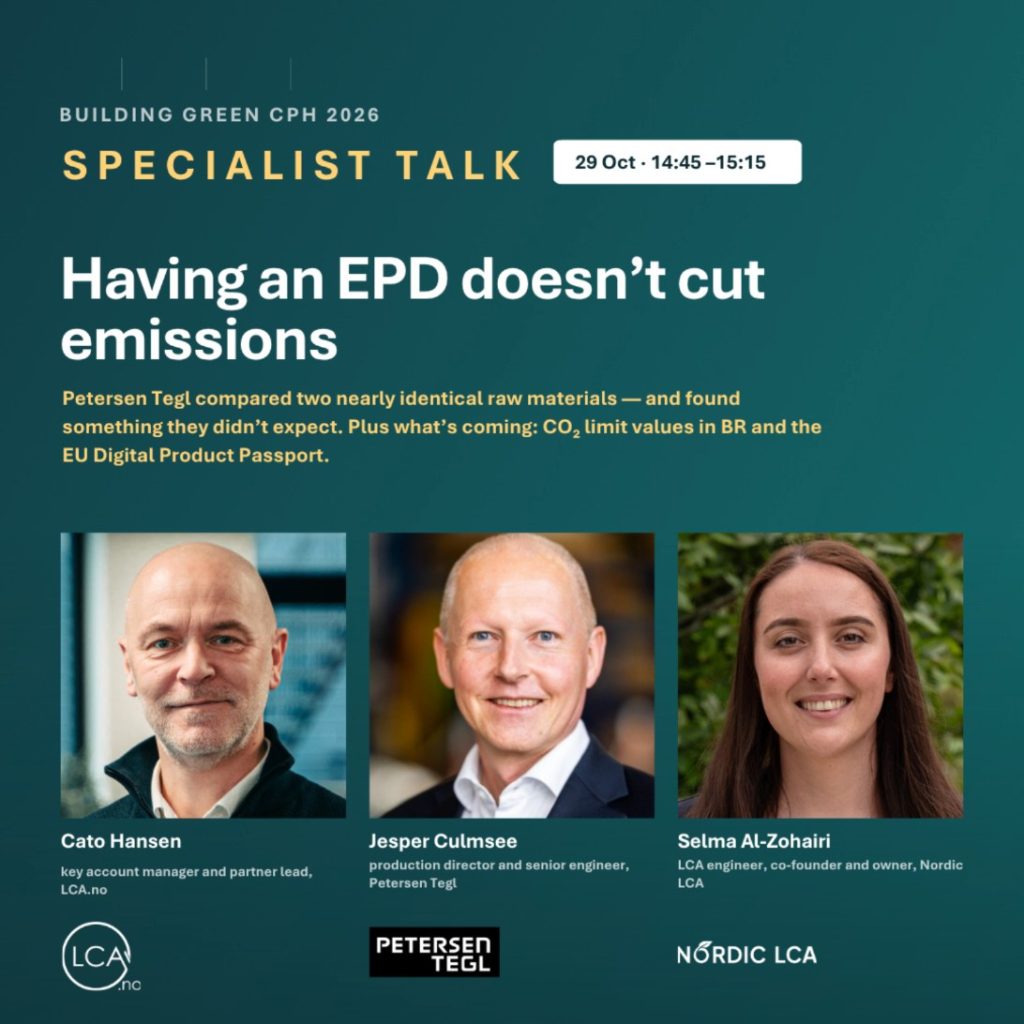
On Thursday 29 October, 14:45–15:15, LCA.no hosts a specialist talk on Platform 2 titled “Having an EPD doesn’t cut emissions”. Cato Hansen, Key Account Manager at LCA.no, Jesper Culmsee, Production Director at Petersen Tegl, and Selma Al-Zohairi from Nordic LCA start from a case from Petersen Tegl. They discuss how working with EPDs can drive change in a company and talk about the EU’s Digital Product Passport.
What will the product passport mean for you?
Book an advisory call, and we’ll look at where you stand with your EPDs and what needs to be in place before the requirements arrive.
Book an advisory call about the Digital Product Passport
This article was first published as sponsored content in Dagens Byggeri on 26 October 2026.