


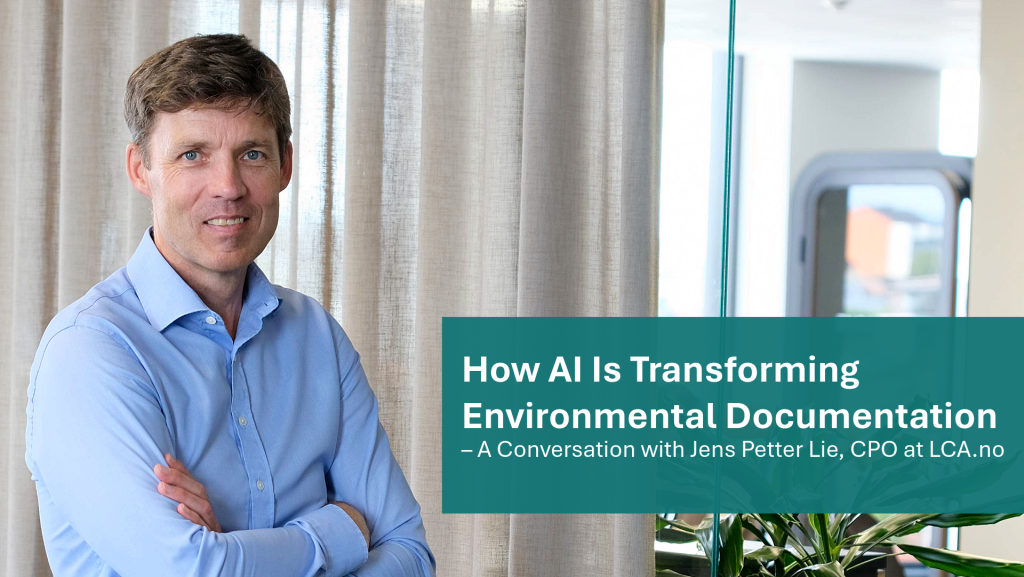
A Conversation with Jens Petter Lie, Chief Product Officer at LCA.no
After more than 20 years of product development experience at Tandberg and Cisco, Jens Petter Lie joined LCA.no as Chief Product Officer on January 1, 2026. In his new role, he combines deep domain expertise with modern technology. According to Lie, the real value for customers lies at the intersection of data, expertise, and AI.
From Global Scale to a Norwegian Expert Environment
Jens Petter Lie has built much of his career around products used by millions of people every day. For two decades, he worked at Tandberg and Cisco (Tandberg was acquired by Cisco in 2010), where he was responsible for product portfolios within video conferencing and collaboration—from hardware and software to complete platforms operating on a global scale.
“My role was largely about combining technology, user experience, and business objectives, while ensuring that complex solutions actually worked well in practice and at scale,” he explains.
What has driven him throughout his career is not the technology itself, but the value it creates for users. Early on, his teams worked with what today would be called AI—cameras that understood who was speaking, audio processing that adapted to the room, and analytics capable of interpreting the context of a meeting.
“The goal was never the technology itself, but creating better workflows and better decisions for users,” says Lie.
Why LCA.no?
The leap from global collaboration technology to a Norwegian scale-up may seem significant. For Lie, it was less dramatic than it sounds.
“Although the domains are different, the challenges are surprisingly similar. In the LCA industry, you work with complex datasets, strict requirements for quality and documentation, and a strong need for effective digital tools. At the same time, this field has enormous societal value.”
During the recruitment process, he quickly recognized something unique about LCA.no: the combination of deep domain expertise and technology—a combination he strongly believes in.
For Lie, it was essential to see that LCA.no does not view technology as an addition to expertise, but as an integrated part of it. In a market where many companies struggle to connect deep domain knowledge with modern digital development, he felt that LCA.no had made a conscious decision that the two should grow together-not in parallel.
“AI Amplifies What You Already Have—Both Strengths and Weaknesses”

Det som faktisk endrer seg nå
AI has evolved from a niche concept into something appearing everywhere, from strategic roadmaps to marketing campaigns. Lie is convinced that the changes ahead are real—but perhaps not where people expect them.
“The most important change will be how knowledge and decision support become available in everyday work. AI will increasingly become an integrated part of workflows—not as an experiment, but as a tool that helps people work faster, more accurately, and with better visibility.”
What distinguishes today’s AI wave from previous ones is not that AI suddenly exists. The difference is that it has moved from the engine room into the user interface.
“In the past, AI was often hidden inside systems—for example in cameras or audio processing. Today, users can interact directly with AI, ask questions, and receive recommendations,” he explains.
However, one thing has not changed: without high-quality data and strong domain expertise, AI creates little value. Lie is clear about what separates companies that are genuinely prepared for AI from those merely using it as a marketing term.
“It all comes down to the foundation. Companies with structured, quality-assured data and strong expert environments have a real opportunity to succeed. Those that don’t risk automating and scaling mistakes.”

AI Meets Environmental Documentation
In regulated fields such as verified environmental documentation, data quality is especially critical. Results must be accurate, traceable, and consistent. Weak data does not simply lead to poor answers—it leads to incorrect answers delivered faster than ever before.
This is exactly where Lie sees the greatest potential for new technology. When used correctly, AI can support the entire process surrounding an EPD or life cycle assessment.
“AI can support the entire process—from structuring product data, through calculations and analyses, to quality assurance of the results. It can also help users understand what information is missing, which choices influence outcomes, and where opportunities for improvement exist.”
For Lie, this is more than a technical opportunity—it is central to how LCA.no wants to support its customers. The ambition is not simply to deliver documentation, but to be a partner that helps customers improve their products. This includes both reducing environmental impact and identifying commercial opportunities through better insights and recommendations.
Standards and regulatory requirements are not becoming simpler, but the way people work with them can become easier.
“The standards will remain complex, but AI can serve as an intelligent guide that helps users navigate requirements correctly. It’s not about replacing expertise—it’s about making expertise more accessible and actionable.”
For companies that lack control over their product data, Lie believes the pressure will only increase. Requirements for verified environmental documentation are tightening through regulations such as ESPR, CSRD, and the Digital Product Passport, among others. Poor data management is becoming a genuine business risk—one that AI will expose much faster than manual processes ever could.
This applies not only to organizations producing EPDs themselves, but also to buyers, developers, and others who increasingly rely on environmental documentation. As data and documentation move more efficiently throughout value chains, those lagging behind will quickly feel the consequences—through lost contracts and higher compliance costs.
Working Smarter Without Compromising Quality
A common concern in knowledge-intensive industries is that AI will lower the standard of what is considered good enough. Lie sees the opposite.
“AI is extremely effective at checking consistency, identifying deviations, and suggesting improvements. At the same time, people and expert communities remain responsible for the final assessments.”
Repetitive and manual tasks that once consumed experts’ time can be automated, freeing capacity for the professional judgments where human expertise truly matters.

How LCA.no Uses AI Today
At LCA.no, AI is not something added on afterwards. It is embedded in the way the company works.
“We see AI as an important part of everything we do. That applies both to daily work, product development and prototyping, and as a driving force behind the services we provide.”
In practice, this means AI is used for data structuring, support in calculations, improvement recommendations, and quality assurance—while maintaining a constant focus on data quality.
Lie believes this is exactly where LCA.no’s strength lies:
“We combine deep LCA expertise with clear technological ambitions. We build solutions where expertise, data, and technology are closely integrated. That creates a solid foundation for using AI in a responsible and value-creating way.”
“Start with your data and your expert teams. AI is not a magical layer on top—it is an amplifier of what you already have.”
What Customers Will Expect
Customer expectations of digital tools will change significantly over the coming years—and much of that transformation is already underway. Simply collecting data will no longer be enough; tools must provide insights and help users take action.
“Customers will expect guidance, insights, and decision support—tools that help them make the right choices faster and with higher quality.”
For companies looking to position themselves for the future, Lie has one clear recommendation: invest in data, structure, and expertise first. AI is an amplifier, not a replacement.
That is also how LCA.no has chosen to build its business: expertise first, technology close behind, and AI as the engine that makes everything else work better.
For Jens Petter Lie, this has been the common thread throughout his career—from video systems that interpret what happens in a meeting room to software that interprets a product’s environmental footprint. Good technology is not about showcasing what it can do; it is about reducing friction for the people who use it.
And in an industry where more and more organizations must understand, document, and improve their environmental impact, that philosophy has suddenly gained a much broader reach.