



Published on Heidelberg Materials Italia’s website blog on 04.05.2026
Categories: Corporate | Products and Solutions | Sustainability
In the construction sector, sustainability is no longer just a statement of intent: it has become a measurable, documented, and verifiable requirement. At the heart of this transformation are EPDs, Environmental Product Declarations, technical tools that are redefining market rules.
The numbers speak clearly. EPD International, the longest-running global program, founded in Sweden in 1998, surpassed 18,000 valid and registered EPDs by mid-2025, published by companies in nearly 50 countries. In 2025 alone, 9,395 new EPDs were published—an absolute record. The construction sector is the main driver of this growth: 86% of EPDs issued by EPD International in 2025 concerned construction products, confirming the central role that the building industry plays in the transition toward greater environmental transparency. European regulations, minimum environmental criteria, building certifications, and supply chain demands are making EPDs an increasingly strategic tool for accessing the market.
In Europe, the picture is equally dynamic, with each country telling a different but converging story. In Germany, IBU published over 840 EPDs in 2024 alone, surpassing 4,700 total declarations since 2012. In France, the INIES database contained, as of December 31, 2024, more than 6,300 registrations between FDES and PEP for construction products and equipment. A particularly significant case is Norway: EPD Global, a founding member of ECO Platform, has more than 8,600 declarations published as of mid-2025—an extraordinary number for a country of just over 5 million inhabitants. At the beginning of 2024, 370 companies had published 3,259 EPDs through the program, with an average of nearly 9 EPDs per company; there were just 3 in 2013. The dramatic leap that followed has a precise explanation: as of January 1, 2024, Norwegian public buyers are required to weight environmental and climate criteria for at least 30% in tender evaluations. A signal of what happens when public regulation truly enters the picture.
In Italy, the trajectory is the same. As of June 1, 2024, EPDItaly had published 542 EPDs, covering 91 different types of products and services, with 57% of declarations compliant with the EN 15804 standard. Analyzing the historical series between 2018 and 2023, a steady growth emerges, with a 49% acceleration in the 2022–2023 biennium—a sign that the market was already moving toward greater environmental transparency well before the new regulatory obligations. At the European level, Eco Platform data shows that the number of certifications has doubled in just two years.
This article explains what they are, why they really matter, and above all, how they are already changing the choices of those who design, purchase, and build. We do this through the direct voice of Giovanni Pinto of Heidelberg Materials Italia, a construction materials company that has chosen to certify its products using LCA.no software.
What Are EPDs?
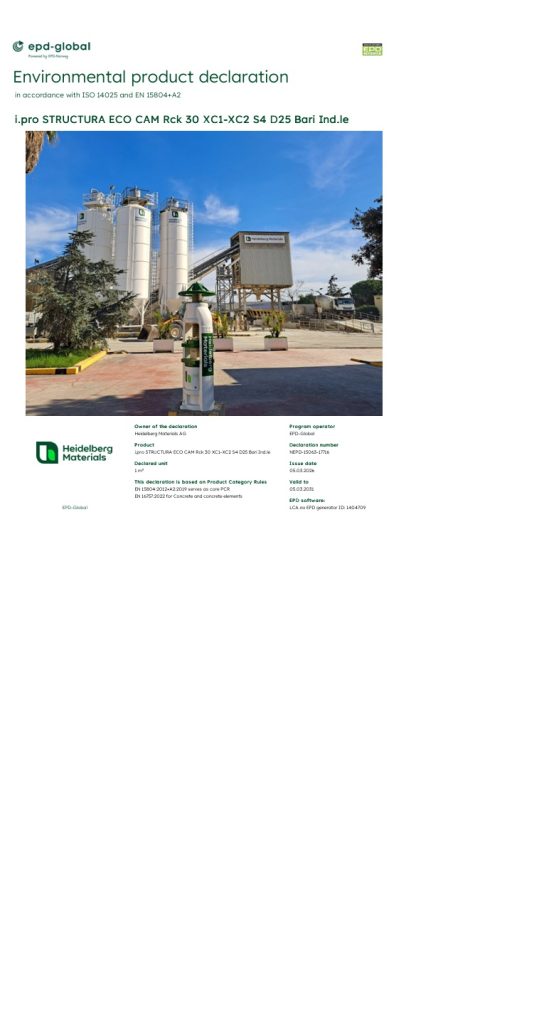
An EPD (Environmental Product Declaration) is a standardized document that communicates the environmental data of a product throughout its entire life cycle: from raw material production, to transport, to use, to final disposal. It is based on a scientific methodology called LCA (Life Cycle Assessment) and is verified by an independent third party before publication.
Unlike simple greenwashing, where companies generically declare themselves “sustainable,” an EPD reports precise numbers: how much CO₂ equivalent is emitted, how much water is consumed, how much material is extracted. It is, essentially, the environmental ID card of a product.
EPDs follow international standards such as ISO 14025 and EN 15804 (specific to the construction sector). Each declaration must comply with the Product Category Rules (PCR) defined for each product type.
How did you decide to start the EPD certification process for your products? Was it a commercial choice, regulatory, or both?
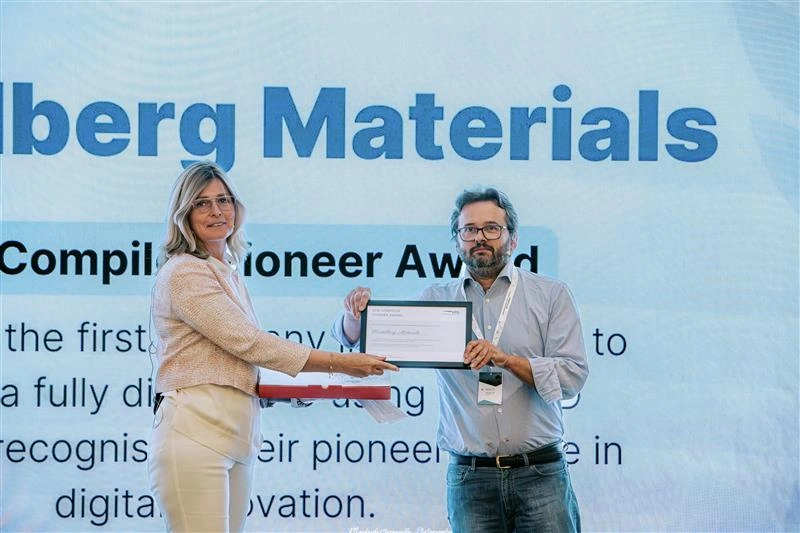
“The choice was both commercial and regulatory. The first EPDs were drafted several years ago to promote innovative products such as sulfo-aluminate cements and draining concretes. Subsequently, with the advent of CAM (Minimum Environmental Criteria) and construction sustainability protocols (LEED, BREEAM), it was decided to move to EPD Process certification to structure the entire process of studying and issuing environmental product declarations.”
Why EPDs Have Become Essential
The Market Demands Them
Demand for environmental transparency has grown exponentially. Designers working on LEED, BREEAM, or DGNB certified buildings necessarily require EPDs for the materials they specify. European public tenders are increasingly requiring verified environmental documentation as a participation requirement.
Have you already received EPD requests from designers, general contractors, or public clients? In what context: tenders, green building, private procurement?
“We continually receive EPD requests from public and private clients, mostly to meet Minimum Environmental Criteria and for green building. However, more and more companies are requesting EPDs to redesign their products with a view to improving environmental performance, especially for circularity characteristics and lower carbon footprint.”

Roberto Conte, draining pavement made with i.idro DRAIN for the Barcarello seafront, Palermo
European Regulation Is Accelerating
The European Green Deal and the Construction Products Regulation (CPR, 2024 revision) are shifting EPDs from option to obligation. The principle of the Digital Product Passport, currently being implemented, will require every product placed on the EU market to have traceable and verifiable environmental data.
What changes with the new CPR (2024) The 2024 revision of the CPR introduces three practical changes relevant to material producers:
- Declared performances must be consistent with the requirements of national building codes, using calculation methods shared at the European level. EPDs become the recognized format for communicating these performances comparably across countries.
- For the first time, a basic requirement on environmental sustainability (BR7) is introduced, requiring products to also be evaluated in terms of life-cycle impact. Harmonized standards will define calculation methods in line with EN 15804 and LCA, making product-specific EPDs the main tool to demonstrate compliance.
- The CPR connects to the Digital Product Passport (DPP), which will require structured and traceable environmental data for every product placed on the EU market. Those who already have an EPD based on real process data are, in fact, already prepared. Those who move today have the advantage: they will not have to adapt under pressure tomorrow.

Roberto Conte, detail of pavement made with i.idro DRAIN
Internal Data That Emerges from LCA
One of the often-underestimated effects of EPD certification is the quality of the data collected during the LCA process. For the first time, many companies obtain a complete and quantified view of their impact: which production phase contributes most to emissions, which raw material suppliers contribute to embodied carbon, where the concrete opportunities for improvement lie.
During data collection for the LCA, did you discover something unexpected about your processes or supply chain? Was there a piece of data that surprised you?
“There were no real surprises; rather, we appreciated the potential of a systemic approach to LCAs that allows us to autonomously evaluate and compare different products.”
How an EPD Is Built: The Role of LCA
The process for obtaining an EPD is divided into precise phases. Everything begins with a complete LCA (Life Cycle Assessment), which analyzes every stage of the product’s life cycle: extraction and transport of raw materials (A1-A3), construction on site (A4-A5), building use (B1-B7), end of life and recycling (C1-C4).
The main impact categories measured include:
- GWP — Global Warming Potential (CO₂ equivalent, climate-altering emissions)
- ODP — Ozone Depletion Potential
- AP — Acidification Potential
- EP — Impact on aquatic ecosystems
- PENRT / PERT — Consumption of non-renewable and renewable primary energy
Once the LCA is completed and the declaration drafted, it is submitted for verification by an accredited third-party verifier. Only after passing verification is the EPD registered in an official program, such as EPD Global or EPD Italy, and made public.
How much time and how many internal resources did the LCA data collection process require? Did you encounter difficulties with supplier data or internal processes?
“The data collection process was not particularly complicated, having structured industrial reporting systems in all the businesses involved. Initially only two resources were involved; we are now moving to four resources due to the need to more efficiently separate the steps of compiling and approving the LCAs.”sigenza di separare in maniera più efficiente gli step di compilazione e approvazione delle LCA».
From Complexity to Operational Simplicity
A software platform developed to support producers and consultants in the EPD generation process aims to eliminate the technical barriers that traditionally made LCA accessible only to large companies with dedicated resources.
Heidelberg Materials has chosen LCA.no as a partner to manage the entire EPD certification process for its products.
What convinced you to choose it over other tools or external consultants? Which features do you use most?
“Our system was already structured with the use of a certified LCA Tool. The transition to LCA.no allowed us to optimize the subsequent phases of issuing and approving final documents, moving from manual operations to almost completely automatic functions. For the future, we plan to fully automate the process by adapting the company’s data structure.”
How many EPDs have you already published or have in progress? Which products did you prioritize and why?
“Heidelberg Materials Italia has currently published about 40 EPDs across different Program Operators, and we plan a further increase with a gradual transition to the single operator LCA.no/EPD Global to have everything concentrated on a single platform.”
EPD as a Commercial Lever: Concrete Benefits
Beyond regulatory compliance, EPDs are becoming a commercial differentiation tool. In a market where products increasingly compete on similar technical characteristics, verified environmental transparency is a distinguishing element that is difficult to replicate without a serious process behind it.
Have you already seen a direct commercial impact from the publication of your EPDs? New clients, access to tenders, or different conversations with designers?
“Having EPDs available gives us an important commercial advantage as bearers of a new language in a context of great ferment in the field of sustainability. Furthermore, the maturity of our EPD process is such that it gives us a different sensitivity to the final data of our declarations or to responses to client/designer requests.”
The competitive advantage lies not only in having the EPD, but in having built it on solid and updated data. An EPD based on generic sector data is much less effective than a product-specific one based on real production process data, because it allows demonstrating actual performance, which is often better than the sector average.

Roberto Conte, Genoa San Giorgio Bridge
Conclusion: The Time Is Now
EPDs are no longer the frontier of sustainability—they are becoming the minimum standard. The construction sector is in a phase of accelerated transition, driven by European regulation, market demand, and a design culture increasingly attentive to environmental data.
Producers who move today acquire three simultaneous advantages: deep knowledge of their processes, verified credentials in the market, and a positioning that will be increasingly difficult to achieve for those who wait.
The advice I would give to other producers? Don’t wait for clients to ask you. By the time they ask, it’s already too late to prepare properly. — Giovanni Pinto, Heidelberg Materials Italia
© ALL RIGHTS RESERVED

Daniela Hovland
Key Account Manager LCA.no
With over 15 years of experience in developing client relationships across various sectors, she connects business growth to sustainability, transforming complex needs into concrete opportunities. She holds the role of Key Account Manager at LCA.no, a company headquartered in Norway but with an increasingly international positioning. LCA.no was born as a spin-off of NORSUS, one of the leading European research institutes in the field of life cycle assessment (LCA) and sustainability. This scientific origin represents a fundamental distinguishing element: the company’s approach is based on rigorous methodologies, verifiable data, and consolidated expertise, offering reliable solutions in an increasingly complex regulatory context. Founded in 2016, LCA.no develops SaaS (Software as a Service) tools designed to simplify and digitize the management of environmental documentation. Its platforms allow companies to create, manage, and update EPDs, LCA analyses, and climate reports in an efficient, scalable manner, compliant with international standards, significantly reducing time and operational complexity. For the Italian market, this approach represents a concrete advantage: it allows companies, particularly in the construction, manufacturing, and industry sectors, to address growing regulatory requirements (such as CAM, DNSH, and the EU taxonomy) with greater agility, without having to develop highly specialized internal expertise. At the same time, the scientific solidity derived from NORSUS guarantees a high level of credibility, increasingly required also by Italian clients, partners, and stakeholders. While maintaining its headquarters in Norway, LCA.no is now increasingly active and relevant in Italy, where demand for advanced digital tools for sustainability is growing strongly. The company therefore positions itself as a bridge between Northern European scientific rigor and the concrete needs of the Italian industrial fabric.